
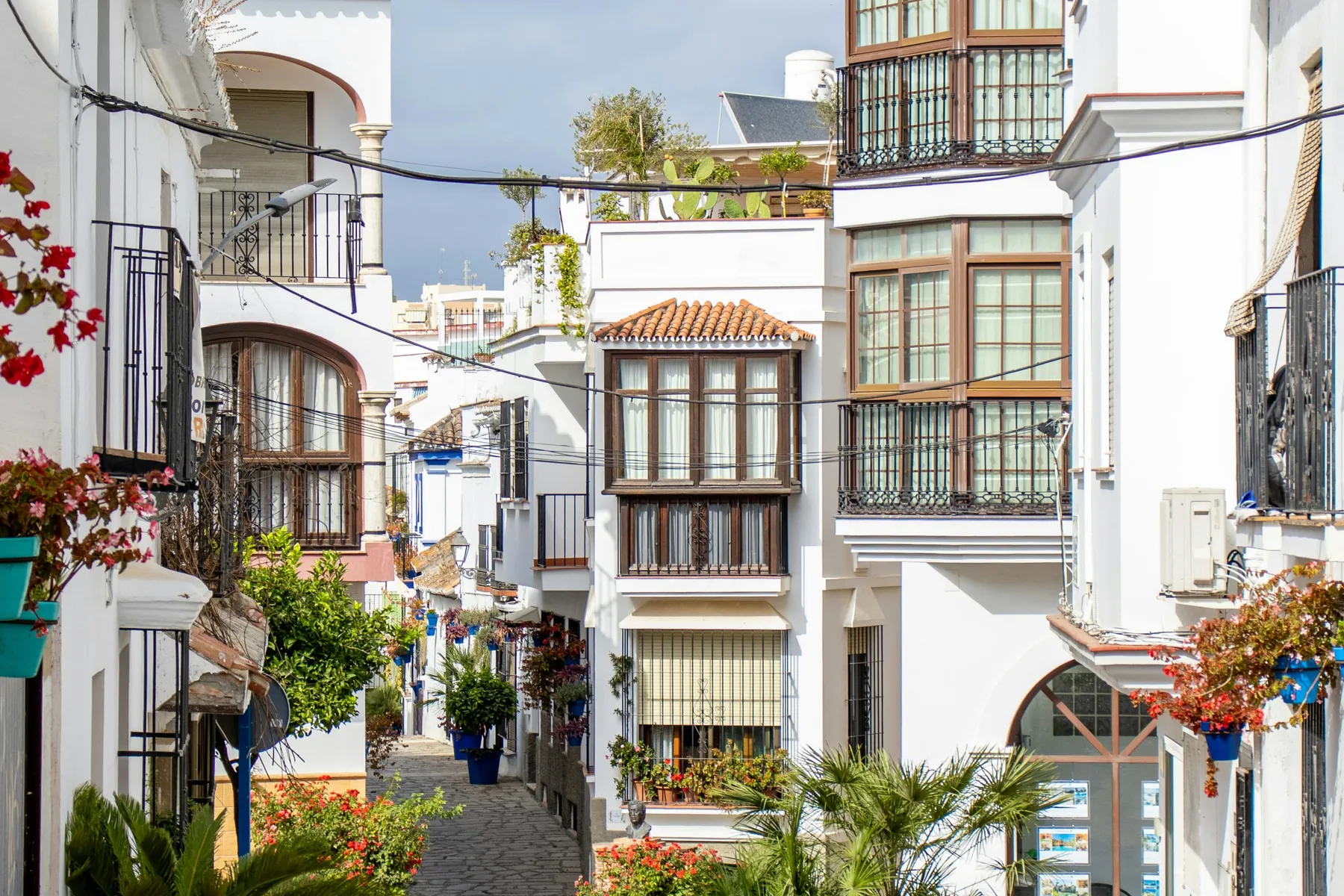
Almost everything written about Estepona’s old town is written between noon and four. That is when the lanes are most photogenic: whitewash, flowerpots, a table in the shade on the Plaza de las Flores. All accurate; none of it tells you what living there is like. A place at midday has its good coat on.
I have started many days in that grid of streets, usually because a viewing was booked for the afternoon and I wanted to know what I would be showing. The early hours are a different town, and the honest one. It is why I ask nearly every buyer to give up one morning’s sleep.
Six: the sea before anyone is on it
At six the water at Playa de la Rada is flat and grey and belongs to nobody. It has no colour yet; the sun is still coming up off the water to the east. The promenade carries people going somewhere — a swim, a shift, a dog — not people looking at something, and that traffic tells you who lives in a street.
West along the front, the harbour is two things in one basin: the Junta classes Puerto de Estepona as deportiva y pesquera, a leisure marina and a working fishing port in the same water. At six it is obvious which half is which — the yachts sleep, the fishing side has an auction hall, an ice plant and people carrying things. Buying near the port, find out which of the two your bedroom faces.
The light is the argument for the hour. It comes off the water instead of down onto it, so a terrace that is a furnace at three is the best room in the house at seven, and a north-facing patio that looked cool at midday never takes any sun. Orientation cannot be renovated, and an afternoon viewing is the worst way to read it.
Seven: the town resupplies itself
The historic centre is a pedestrian zone, not a calmed street with a sign. That is the pleasure of it, and it has a consequence people meet after they move: everything a bar, a shop or a household needs crosses paving where a van cannot pull up. So the centre is resupplied early, while there is room. Watch how that is solved outside the door you are considering; it is the route your furniture will take.
Then the shutters go up and the street tells you what it is for. Calle Real carries the town’s own daily trade — the pharmacy, the ironmonger, the fish shop — and at seven the proportion is plain: how much of the ground floor serves residents, and how much stays shut until the visitors arrive. A street that opens at eleven empties in November.
By eight there is a queue at the bakery: two men who have had this conversation before, a woman with a dog that knows the route better than she does, somebody’s grandmother with a list. The first coffee of the day is drunk standing up. It is the least photographed thing in the town and the most reliable.
A town that only works between twelve and four is not a town. It is a season.
Eight: what you can only hear
Sound is what buyers underestimate most, in both directions. A pedestrianised street takes away engines and gives back voices, dragged chairs, a shutter, the refuse lorry, bouncing between two rows of tall façades. In August that runs past midnight; in February the same street is quiet enough to hear the Torre del Reloj, free of the church it belonged to, mark the hour.
The school run is in the same hour and on foot, because the state schools sit inside the town, not out on a bypass — so a residential street carries children between eight and nine, which says more about the neighbours than about the noise. Take a wall or the step of a church and stay long enough to stop being a visitor. Things to notice:
- Where the wind comes from at seven, and whether the terrace you are paying for sits in it.
- Which side of the street is still in shadow at eight, and how long it stays there.
- How many flights there are to the door. Most old town blocks have no lift, and a shopping bag on the stairs at eight tells you more than a floor plan.
- Who greets whom. A street where nobody says good morning at eight is telling you how often its owners are here.
The buyer who only ever comes at midday
Here is the mistake, and it is expensive. A buyer flies in for three days in May, views between twelve and four because that is what the diary allows, and buys the town at its most flattering hour in one of its most flattering months. What they saw was real, and it was a very narrow sample.
So I ask for three tests, and the morning is the first. The second is that street at eleven at night in high season, because a terrace under a bedroom window sounds nothing like it looks in a photograph. The third is a weekday out of season: February here is quiet but not shut — the Plaza de las Flores restaurants stay open, the municipal Orquidario all winter — which is the difference between a town and a strip. None of the three is about atmosphere; I can only tell you where to stand.
One morning, before you decide
When you come over for a week of viewings, leave one morning with nothing in it. Walk from the address to the bakery, from the bakery to the promenade, and back up through the streets as the shutters open. Buy nothing, ask nobody, give it the whole hour. The old town is small enough to cross before the first terrace is laid out: you will have seen it work before it was set out for you.
If the town reads well at seven, it will read well at three. The other way round does not hold, and that is the whole argument. If it does not, tell me: that is a result too, and it costs nothing now and a great deal after the notary. Say so when you write, and the empty morning goes into the week.