
Ten houses in three days is a sane schedule. It is also the fastest way I know to fly home confused. The difference is never stamina: by the seventh house, a buyer who has written nothing down has stopped comparing houses and started comparing moods — and the last one always wins, because it is the only one still in focus.
Almost everything that goes wrong on a viewing trip goes wrong in the week before it, not during it. So: how I prepare three days of viewings on this coast, what I ask in every single house, and what has to be settled before you fly home — and what does not.
The brief you write before you book the flight
Having a look around is the most expensive way to look. Every house you walk through that you were never going to buy costs attention you needed for the serious ones — and on a viewing trip it is attention that runs out, not time.
So I start from a brief you can reject with. Not a wish list — those only grow — but a short set of conditions: which rooms have to be on one level, and whether a pool that sits in shade by late afternoon is a detail or a deal-breaker. Conditions cut a list. Wishes do not.
An area name is not a brief either. Elviria is the clearest example on this coast: the land climbs fast from the beach, so two houses both honestly described as Elviria can be a sea-level life and a mid-slope one — a different drive, a different breeze, a different garden. Decide which band you are shopping in before you land, and half the list rejects itself.
The hour of the day decides what you see
A south-west terrace at eleven in the morning tells you nothing you can use. It will be pleasant, evenly lit, and completely silent about the only thing that matters: what that terrace becomes when the sun comes round at the end of the afternoon.
So I build the days against the clock rather than the map. Hillside addresses early, while the light is still flat and you can read the plot and the retaining walls. Houses at sea level later, when the glare has gone off the water. A house whose case rests on its terrace gets the hour that terrace deserves.
I would rather drive the same road twice than show you a terrace at the one hour of the day it flatters itself.
Areas get the same treatment: where I can, you see the same area twice — a weekday and a Saturday, daylight and after dark. Sierra Blanca sits on the hillside above the Golden Mile, and what that altitude means is something you learn on the climb at the end of a long day, not from a terrace at noon.
Ask the same questions in every house
You can only compare things you measured the same way. So I use one short list, in the same order, in every house — including the ones you already know are wrong, because those are what calibrate the rest.
- Where the sun is now, and where it will be at the end of the day: terrace, kitchen, main bedroom.
- What you hear with the doors open: the road, a pool pump, a padel court, dogs, the neighbour’s gate.
- How you arrive: the last stretch of road, the entrance, whether a delivery van can turn.
- What the house does in winter: heating, glazing, which rooms never catch the sun.
- What has been altered since it was built, and whether the paperwork exists — the file, not the story. Your abogado confirms that, not the agent.
- The one thing you would have to change before you could live in it, and what that would involve.
Two minutes per house, typed into your phone in the car before the next one, not at dinner. The list is dull on purpose: it survives fatigue, and on day three it has not blurred.
Half of what you are buying is outside the house
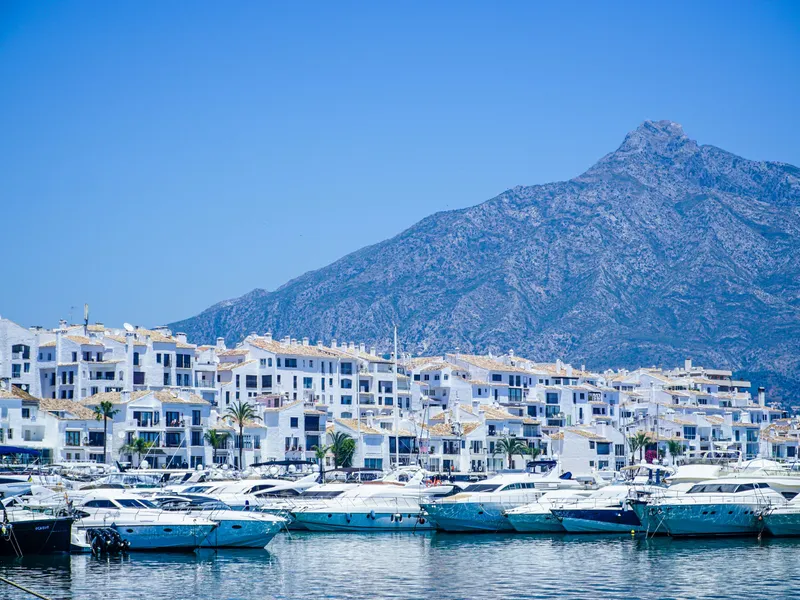
Four addresses on one shortlist can all say Marbella on paper — Puerto Banús, Nueva Andalucía, San Pedro de Alcántara and Elviria all sit in that municipality — and still be four different weekday routines. The house is the part you choose; the routine is the part that comes with it.
So I drive the routine with you, not just the route to the front door: the school run at the hour it actually happens, the supermarket you would use on a Tuesday, the road to the airport on a working morning rather than an empty Sunday. The least photogenic part of the trip is the one that changes minds most often.
Arrival counts too. At La Zagaleta every arrival passes a controlled entrance, so I drive in with you rather than meet you inside: that gate is what you repeat every day. And ask, place by place, what stays open once the season ends — in Cabopino the marina trades through the winter, while a street that was full in August can be a different street in February.
What day three decides, and what it does not
The same evening, before dinner turns the day into one long corridor, we go back through the houses in order and give each one a verdict in a sentence: in, out, or in only if something specific changes.
So the shortlist is settled on day three, while the houses are still separate objects in your head. Not because a house will be sold out from under you — I cannot promise that, and would not use it as an argument — but because memory averages. A week at home turns ten specific houses into one imaginary house that does not exist.
What day three does not settle is the purchase itself. Ranking ten houses needs a clear head at the end of the trip; committing to one of them is a slower matter, and there is a piece in this journal on why a good purchase outlasts the trip booked for it. Sometimes the honest conclusion on the first evening is that ten was the wrong number, and then we cut and see five properly. Send me your brief before you book, and we will know which of those two trips this is.