

Estepona · Málaga
Coordinates 36.4257° N · 5.1452° W
Estepona's old town, read from the Torre del Reloj down
Estepona old town is the lived-in historic centre of a working Andalucian coastal town, where the Ayuntamiento has pedestrianised more than 130 streets and hung them with flowerpots. Its stock is small whitewashed houses and low apartment blocks, bought mostly by people who want a walkable Spanish town rather than a resort.
- Municipality
- Estepona
- Province
- Málaga
- Postcode
- 29680
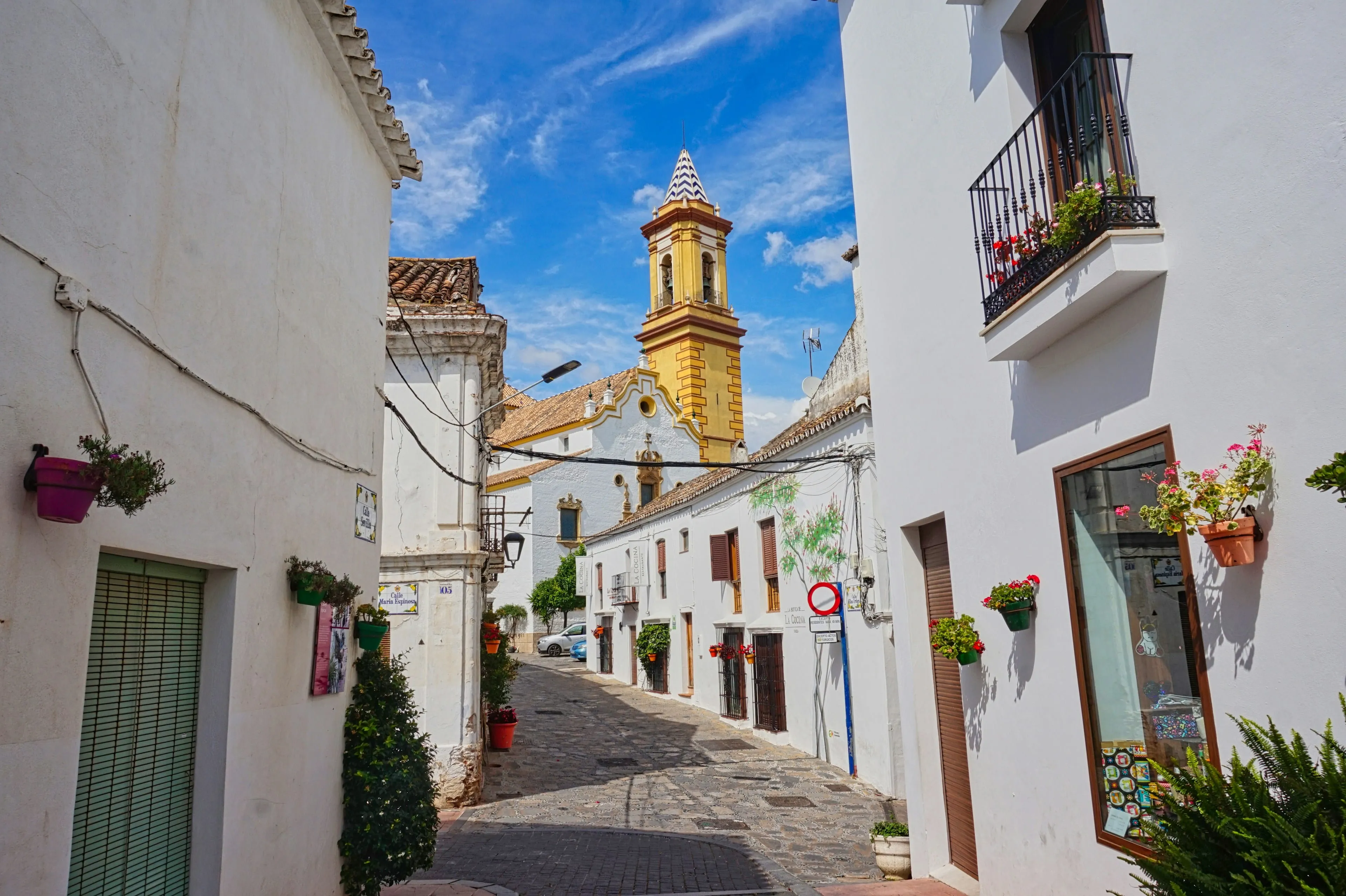
Estepona's old town is a working town centre, not a quarter preserved for visitors. Behind the seafront runs a grid of narrow whitewashed streets that the Ayuntamiento has spent a decade taking cars out of: more than 130 of them are now pedestrian, relaid in stone and hung with flowerpots under the municipal Jardín de la Costa del Sol programme. The Torre del Reloj still marks the hours from the middle of it, left standing alone after the 1755 earthquake ruined the church it belonged to. The bakery queue at eight in the morning is local, and stays local in November.
Stock here is old and small before it is anything else. Two- and three-storey houses on plots measured in a handful of metres, patios rather than gardens, and roof terraces that are the real outdoor room. Above them sit low apartment blocks from the 1960s and 1970s along the Avenida de España and the streets behind the Plaza de las Flores, most of them without a lift. Renovated units and untouched ones sit on the same street, and the difference between them is usually plumbing, insulation and whether the roof terrace was ever legalised.
Life runs on foot and it runs all year. Calle Real carries the daily traffic of the town rather than the tourist traffic — pharmacy, ironmonger, the fish shop, three generations of the same family at a table outside. The Ruta de Murales Artísticos has put 64 painted façades across the town, which changes the feel of an ordinary residential block more than a guidebook can explain. February is quiet but it is not shut: the restaurants on the Plaza de las Flores stay open, the promenade fills at six, and the municipal Orchidarium keeps its doors open through the winter.
The honest caveat is access. A pedestrianised centre is a pleasure to live in and a nuisance to arrive at. Deliveries, removals and anything involving a van need planning, residents' parking is a separate transaction from the flat, and a fourth-floor walk-up is a decision about the next twenty years, not the next two. Buildings this age also carry the ordinary Spanish problems of shared drains, party walls and a comunidad de propietarios whose reserve fund may be thinner than the roof it is meant to cover.
Paula's read on the market is that the centre trades on being genuinely inhabited. Buyers who come here have usually already looked at the beachfront strips further east and decided against them. Demand is steady rather than seasonal, because the same qualities that make a house here work in July make it work in January. The constraint is supply: the old town has a fixed footprint, nothing new is built inside it, and a good renovated house on a wide street is a rarer thing than the volume of listings west of the port suggests.
The core is pre-industrial: single-aisle houses of two or three storeys, load-bearing walls, small windows, a patio and a flat roof used as a terrace. Around it sit the town's first apartment blocks, mostly 1960s and 1970s, four or five storeys, balconies to the street, and stairs rather than lifts. Very little is contemporary; where it is, it is a gutted shell behind a protected façade. Renovation stock is plentiful and honest — the walls are sound and everything inside them, from wiring to drainage, is usually the project.
Mornings belong to the market and the bakeries; the town eats late and eats out on the Plaza de las Flores and the streets around it. The school run is short and mostly on foot, because the state schools are inside the town rather than on a bypass. Sound is the thing people underestimate: a pedestrianised street carries voices, chairs and rubbish lorries, and a bar terrace under a bedroom window is audible until well after midnight in August. In February the promenade still fills at six, the Orchidarium stays open, and the restaurants that matter never closed.
It suits people who want a Spanish town rather than a coastal address: year-round residents, buyers who intend to speak Spanish, and anyone whose ideal Saturday is on foot. It does not suit a family that needs two parking spaces and a garden, a buyer who wants a pool without a shared roof terrace, or anyone with knees that will not want four flights in a decade. If your shortlist is really about beach frontage and a private plot, the centre will disappoint you and one of the strips east of the port will not.
Every row below is verifiable. Where a value is not on public record, the row is left out rather than estimated.
| Municipality | Estepona |
|---|---|
| Province | Málaga, Andalucía, Spain |
| Part of | Estepona |
| Type of place | District |
| Coordinates | 36.4257, -5.1452 Approximate centre of the area, for maps only. It is not an address. |
| Postcode | 29680 |
| Mural route | 64 artistic murals decorate façades across the town's districts as part of the Ruta de Murales Artísticos. Source |
| Pedestrian network | The Ayuntamiento has created a network of more than 130 pedestrianised streets over the past decade under the Estepona, Jardín de la Costa del Sol programme. Source |
| Torre del Reloj | The tower belonged to the 16th-century Iglesia de los Remedios; the 1755 earthquake ruined the church and the tower has stood free ever since, with its clock added in the early 20th century. Source |
| Coastal corridor | The municipal corredor litoral is planned at 23 km, already connects 21 km of shoreline and crosses 17 large timber bridges over the rivers and streams. Source |
| Orchidarium | The municipal botanical park holds around 1,500 orchid species, some 4,000 specimens, over 1,000 square metres on three levels. Source |
| Hospital | Estepona has its own Hospital de Alta Resolución, listed as a centre of the Servicio Andaluz de Salud. Source |
| Beaches | Playa de la Rada & Promenade · Playa del Cristo · Playa del Padrón |
| Marina | Puerto Deportivo de Estepona · Puerto Banús Marina |
| Golf | Valle Romano Golf & Resort · Estepona Golf · Marbella Club Golf Resort |
| Paula works in | English · Nederlands · Español |
| Services here | Buying a home Selling your property Property investment New build & off-plan Rental management Legal & mortgage support |
Every row below is verifiable. Where a value is not on public record, the row is left out rather than estimated.
- The centre is a pedestrian zone, not a traffic-calmed one. Confirm before you offer how a removal van reaches the door, and whether the address carries any residents' vehicle permit at all. ↗
- Most old town blocks have no lift and no legal obligation to install one. On a third or fourth floor this is the single fact that decides resale to older buyers.
- Roof terraces are the most-contested square metres in the old town. Ask the lawyer to check the terrace against the escritura and the Catastro before it becomes part of the price you pay.
- Estepona has its own Hospital de Alta Resolución inside the Servicio Andaluz de Salud network, which is a genuine difference from villages that depend on Marbella or Algeciras for outpatient care. ↗
- The municipal coastal corridor is being built in stages along the whole shoreline, so a seafront flat may sit next to works for a season. Ask the Ayuntamiento which stretch is scheduled next. ↗
- Community fees in a small lift-less block are low, and so is the reserve fund. Read the last three years of minutes for roof, façade and drainage votes before you assume the low figure holds.
What is within reach of Estepona Old Town
Beaches, marinas, golf, old towns and everyday landmarks nearest to Estepona Old Town, drawn from our own mapped points along this coast.
Distances are measured in a straight line from the centre of the area — not by road, and not as a driving time.
Plaza de las Flores
< 0.5 kmOld town
The old town's elegant salon — orange trees, terraces and slow afternoons.
Old Town — Calle Real
< 0.5 kmOld town
Whitewashed lanes strung with flower pots — Andalusia at its most photogenic.
Orchidarium Estepona
0.5 kmNature
Glass domes sheltering 1,300 orchid species — Europe's finest orchid house.
Playa de la Rada & Promenade
0.5 kmBeach
Two palm-lined kilometres of town beach, steps from the old quarter.
Ruta de Murales — Día de Pesca
0.6 kmCulture
An open-air museum of 70+ murals, crowned by a six-façade trompe-l'œil fisherman.
Mirador del Carmen
1.1 kmCulture
Estepona's striking new cultural tower — galleries, auditorium and sea views.
Faro de Punta Doncella
1.3 kmViewpoint
The 1861 lighthouse where the promenade meets the port — golden-hour territory.
Restaurante La Escollera
1.3 kmDining
Legendary quayside seafood by the fishing port — boat-fresh, gloriously simple.
What moves the price here
Inside Estepona the old town sits below the marina front and clearly below the new-build corridor of the New Golden Mile, and above Cancelada and the Casares shoreline further west. It is the one part of the municipality where the premium is paid for walkability and address rather than for sea frontage, which is why a narrow street can carry more weight than a distant sea view.
Street width, whether there is a lift, the floor you land on, a legalised roof terrace, and how far the door is from the promenade. A protected façade caps what you may change outside and lifts the cost of what you change inside.
GUIDE An indication of where this area sits, not a valuation of any particular home. Ask Paula for a figure you can act on.
Questions about Estepona Old Town
-
Can you live in Estepona old town without a car?
-
Yes, for daily life. The town has a food market, supermarkets, pharmacies, banks, the health centre and its own hospital inside walking distance of the pedestrian grid, and the promenade runs from the door. What a car still buys you is the rest of the coast: there is no railway on this stretch, so Málaga airport, the international schools inland and the golf courses all involve a drive. Most residents keep one car and use it twice a week.
-
Do the painted murals restrict what I can renovate outside?
-
The murals themselves sit on specific buildings and are a municipal art programme, not a planning designation. What actually restricts you is the protection status of the building and of the historic centre, which governs façade colour, window openings, balcony ironwork and roof line. The two get confused because they overlap in the same streets. Ask the Ayuntamiento's urbanismo department for the specific classification of the address before you budget a façade.
-
How noisy is a flat above a bar on Calle Real?
-
In August, a great deal, and it does not stop early. A pedestrianised street removes engine noise and replaces it with voices, chairs being dragged and terrace service that runs past midnight, all of it reflected between two rows of tall façades. In winter the same street is quiet enough to hear the clock. The test is to stand outside the address at eleven at night in high season before you make an offer, not at eleven in the morning in April.
-
Where do old town residents actually park their cars?
-
Mostly in underground car parks on the edge of the pedestrian zone, or in a private garage bought separately from the home. Very few old town houses have a garage of their own, because the streets were laid out before cars and most are too narrow for a door. Treat the parking space as a second purchase with its own escritura, its own price and its own community, and check the walk from it to the front door in the rain.
-
Is the centre still alive in January and February?
-
Yes, and that is the main argument for buying here rather than on a resort strip. Estepona is a town with a resident population and a full municipal calendar, so the schools, the market, the health centre and most restaurants run through the winter. What closes is the seasonal beach service, not the town. The practical consequence for an owner is that a home here is lettable and liveable in low season, which is not true of every address on this coast.
— NEXT STEP
Thinking about Estepona Old Town? Ask Paula what is really moving there.
A first conversation costs nothing and commits you to nothing. It usually saves a wasted trip.